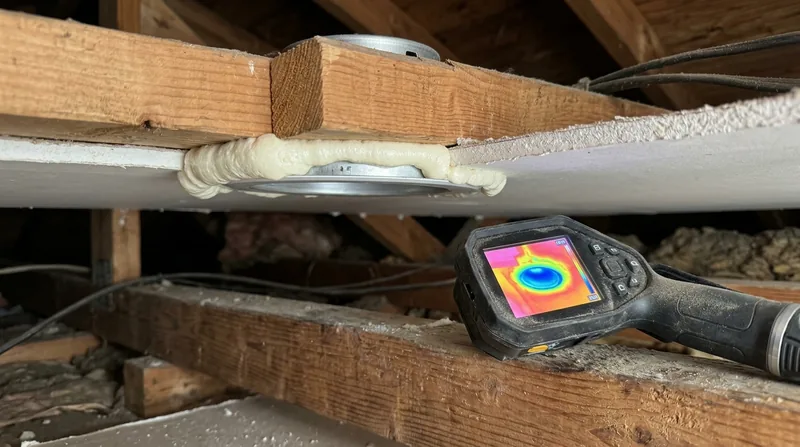




Top plates, can lights, chases and attic hatches pull humid outside air into a Miami house all year. Air sealing in Miami stops that leak before it costs you comfort and money. Miami sits flat and barely above sea level on a limestone ridge between Biscayne Bay and the Everglades, which means every home sits on a concrete slab with no basement, walls are concrete block finished in stucco, and above them a low wood-truss attic runs hot all year long carrying the AC air handler and its ductwork at 140 to 160 degrees Fahrenheit. That temperature differential and the year-round humidity mean vapor drive is always pushing inward through every unsealed penetration. We seal the leaks before we insulate, and it cuts the sticky feel indoors and is the cheapest comfort fix in South Florida. Call us at (786) 503-8206 for a free written estimate, or learn more about our attic spray foam insulation work.
Why Air Sealing Matters in Miami's Hot, Humid Climate
Miami's tropical climate means heat and humidity all year, and vapor drive is always pushing inward through every gap and penetration. A house without air sealing is constantly fighting to cool air that is leaking out while humid air leaks in. The sticky indoor feel, the mold smell in the attic, the higher AC bills, and the rust on metal ducts all trace back to the same root: air leaks that pull outside humidity into conditioned space. Sealing those leaks before you insulate is the foundation of any retrofit that works.
- We seal top plates where the wall meets the attic truss, stopping humid air from rising into the attic.
- We seal can light openings and HVAC chases that bleed conditioned air directly into the unconditioned space.
- We seal attic access hatches and electrical penetrations that let outside air bypass your AC system.
- We seal rim and band joists in older Miami Shores and Coral Gables homes where wood framing meets concrete block.
Sealing these penetrations first cuts the sticky feel indoors, reduces the load on your AC unit, and keeps humidity out of the attic where it drives mold and shortens the life of your ducts and air handler. For more on the insulation that follows air sealing, see our page on closed cell spray foam insulation.
Key info: Miami building code and energy code govern what thermal barrier thickness and ignition barrier you need after sealing. The local building department, not us, decides what applies at your address. Verify requirements with your city before any work starts.
For guidance on local permitting and code, check your city's building department website or contact us at (786) 503-8206 to discuss what applies to your job.
How We Air Seal: The Process and the Payoff
Air sealing is not a one-step spray-and-go. We walk the attic, identify every leak, seal them with closed cell foam, and then insulate on top. The order matters. Sealing first means your insulation sits on a clean, dry surface and does its job. Sealing after means you are sealing around the insulation, which is slower, messier, and leaves gaps. We use mechanical ventilation during cure to manage VOCs, and we name a re-entry window so you know when the attic is safe to occupy.
- We inspect the attic and map all air leaks: top plates, can lights, chases, hatch frames, electrical boxes, and any penetration.
- We seal each opening with closed cell foam, controlling thickness and ratio to manufacturer spec so the seal holds.
- We run mechanical ventilation during cure and post a re-entry window of 24 to 48 hours.
- We then insulate the attic floor or the roof deck depending on your cooling load and ductwork location.
In a typical 1950s concrete-block ranch in Kendall or Miami Gardens with a thin attic and hollow-block walls, sealing the top plate and can lights alone can cut the attic-to-inside air leakage by 40 to 60 percent. The payoff is a cooler house, lower AC bills, and no more mold smell. Learn more about our attic spray foam insulation options after sealing.
Example: A Coral Gables Mediterranean Revival home with a barrel-tile roof and older wood-frame walls raised on coral-rock piers had a sticky upstairs and mold in the attic. We sealed the top plate where the wood framing met the concrete block, sealed the attic access hatch, and sealed the HVAC chase. Three days later the upstairs felt dry, and the AC ran 20 percent less. No insulation added yet, just air sealing.
Air Sealing Methods and Materials
| Approach | Description | Best For |
|---|---|---|
| Closed Cell Foam Sealing | High-density foam (1.5 to 2 lb/cf) sprayed at top plates, chases, and penetrations. Sets hard, holds its shape, and resists moisture. | Miami attics where humidity is constant and the seal must not sag or compress over time. |
| Open Cell Foam Sealing | Lower-density foam (0.5 to 0.7 lb/cf) sprayed at gaps and seams. Softer, flexible, and easier to sand or cut after cure. | Attic corners, rim joists, and areas where you may need to adjust or trim the seal later. |
| Injection Foam Sealing | Low-pressure foam injected into hollow block cavities, rim joists, or wall chases without demolition. Fills voids completely. | 1950s to 1970s hollow-block walls in Hialeah, Kendall, and Miami Gardens where you cannot open the wall. |
| Caulk and Gasket Sealing | Polyurethane caulk or foam gaskets for small gaps, electrical outlets, and trim. Used alongside foam for a complete seal. | Detail work on attic hatches, light switches, and outlets where foam would be overkill. |
Each approach has a place. We choose based on the leak, the substrate, and what will hold in Miami's heat and humidity for years to come.
Air Sealing Cost in Miami: What to Expect
Air sealing in Miami typically starts at $650 for a single-story concrete-block ranch with a straightforward attic and 8 to 12 major penetrations. The price moves up with attic size, the number of penetrations, access difficulty, and whether you are sealing a roof deck or an attic floor. A two-story home in Pembroke Pines or Weston with bonus rooms, multiple HVAC zones, and more complex ductwork will cost more. A sealed attic in a high-velocity hurricane zone home rebuilt after Andrew in Homestead or Cutler Bay may require thicker seals or additional thermal barrier work that adds cost.
The biggest cost driver is labor and access. If your attic is tight, hot, and packed with ducts and insulation, sealing takes longer. If you need to remove failed insulation first, that is a separate line item. If you are sealing a crawl space or a metal building in Doral or the Redland, the scope and conditions change the math entirely. We provide a written estimate with R-value and thickness specs so you know exactly what you are paying for. For a detailed breakdown of our pricing across all services, visit our pricing page.
Get 2 or 3 estimates from local contractors. Look for estimates that name the foam type, the R-value, the thickness of each seal, the re-entry window, and the warranty on workmanship. If an estimate is missing those details or promises a price far below market with no inspection, walk away. Call us at (786) 503-8206 for a free estimate with no obligation to book.
Hiring an Air Sealing Contractor Near Miami: What to Look For
Air sealing is a small-ticket job, which means it is often rushed or cut corners. The contractor who names the foam type, the thickness, the re-entry window, and the warranty on workmanship is the one who knows the trade. The contractor who promises a price sight-unseen, skips the inspection, or guarantees immediate re-entry does not. Miami has local insulation shops, national franchises, and rig-and-run crews from out of state. The local independent with a local address and local plates is your best bet because you can reach them when the smell will not go away or the seal fails.
Before you hire, ask these questions:
- Will you provide a written estimate that names the foam type, R-value, thickness of each seal, and re-entry window?
- Do you carry full insurance coverage and can you provide a certificate of insurance before work starts?
- Will you handle permits and help us understand what the local building department requires at our address?
- Do you have references from homes in Miami, Kendall, or Coral Gables where you have done similar work?
- What is your warranty on workmanship, and what does it cover?
If the contractor dodges any of these questions, call someone else. We are fully insured and provide free estimates with no obligation. Contact us at (786) 503-8206 or visit our contact page to schedule a walk-through and get a written estimate with all the details you need to make a smart decision.
Air Sealing in Miami: Pricing Guide
| Service | Price | Details |
|---|---|---|
| Single-story attic sealing | Starting at $650 | Includes top plates, can lights, chases, and hatch frame sealing in a concrete-block ranch with straightforward attic access and 8 to 12 major penetrations |
| Two-story or complex attic | Starting at $1,200 | Multiple HVAC zones, bonus rooms, more penetrations, or tight attic access that requires longer labor and careful navigation around ducts |
| Injection foam sealing (hollow block walls) | Starting at $800 | Sealing rim joists or wall cavities in 1950s to 1970s concrete-block homes without demolition, priced per linear foot of perimeter |
| Insulation removal plus air sealing | On estimate | If failed or contaminated insulation must be removed first, scope and substrate condition determine the final price |
| Travel | Included | in Miami and surrounding areas, no separate call-out or mileage fee within our service territory |
| Free written estimate | No charge | Response within 24 hours at (786) 503-8206, includes R-value and thickness specs, no obligation to book |
Indicative pricing, the exact cost depends on square footage, finish, and site access. Free personalized estimate within 24h at (786) 503-8206.


