



Miami's tropical climate and unique building stock make closed cell spray foam insulation one of the most effective energy and moisture control solutions in South Florida. Homes here sit on concrete slabs with wood-truss attics running 140 to 160 degrees Fahrenheit most of the year, while humidity pushes relentlessly inward from Biscayne Bay and the Everglades. Two-pound closed-cell foam delivers R-6.5 per inch with its own vapor retarder, shrugging off the flood water that king tides and storm surge bring to elevated floors across Miami Beach, Homestead, and Palmetto Bay. Whether you own a 1920s Mediterranean Revival home in Coral Gables, a post-Andrew high-wind-rated ranch in Cutler Bay, or a metal farm building in the Redland, closed-cell foam stops the heat, seals the air leaks, and controls the moisture that corrodes everything else. We have been installing spray foam insulation across Greater Miami since 2012. Call (786) 503-8206 for a free written estimate, or learn more about attic spray foam insulation and how it pairs with closed-cell applications.
Why Closed-Cell Spray Foam Matters in Miami's Heat and Humidity
South Florida's climate is relentless. Your attic air handler and ductwork run continuously, and every gap in insulation and every air leak around the rim joist or band joist bleeds conditioned air directly into the unconditioned space. Closed-cell foam seals those leaks permanently and delivers a vapor retarder in the same pass, stopping the humid air from migrating into walls and attics where it condenses on cool surfaces and feeds mold, rot, and corrosion. Unlike open-cell foam or fiberglass batts, two-pound closed-cell foam also provides real structural stiffening on the roof deck, which matters in the High Velocity Hurricane Zone that runs from Kendall south through Homestead. In metal buildings and barndominiums across Doral, Medley, and the Redland, closed-cell foam is the only insulation that prevents the steady condensation drip that corrodes steel and destroys stored equipment.
- Delivers R-6.5 per inch with no separate vapor barrier to install or maintain.
- Stops air leaks at rim joists, band joists, and around HVAC penetrations in a single application.
- Resists water absorption and mold better than any other insulation product when properly installed.
- Strengthens roof decks against wind loads in hurricane-rated construction.
- Prevents condensation drip in metal buildings where steel meets humid tropical air.
These advantages are why closed-cell foam is the standard retrofit for older concrete-block homes in Hialeah, Kendall, and Miami Gardens that were built with thin attic fill and no air sealing.
Key info: The Florida Building Code and your local building department govern attic ventilation, ignition barriers, and thermal barriers. Closed-cell foam can be installed under sealed roof decks (unvented attics) or over vented attics, but the code requirements differ. We help you understand what applies at your address and work with your permit process, but the building official has the final say on what is required for your home.
For a detailed look at Florida's requirements, see the Florida Department of Business and Professional Regulation building contractor licensing page, which outlines the contractor registration landscape across the state.
How We Install Closed-Cell Spray Foam in Miami Homes and Buildings
Closed-cell foam is sprayed as a liquid and expands to fill every cavity, crack, and corner. The process requires precision in equipment setup, material temperature, and application technique. We start with a site assessment to measure the space, identify air leaks and moisture sources, and confirm that the substrate is clean and dry. If there is standing water, active leaks, or contamination, we stop and refer you to the appropriate specialist. Once the space is ready, we set up mechanical ventilation and spray the foam to the thickness and density specified by the manufacturer and your building code. The foam cures in 24 to 48 hours, and we provide a re-entry window so you know when it is safe to occupy the space. You receive a written estimate with R-value, thickness, and board-foot quantity before any work begins.
- We assess the space and identify any moisture, leaks, or contamination that must be fixed first.
- We set up mechanical ventilation during application and curing to manage odor and off-gassing.
- We spray closed-cell foam to the specified thickness in controlled passes, maintaining proper drum temperature and material ratio.
- We provide a written estimate and a clear re-entry timeline before you book the job.
- We coordinate with your local building department if permits are required at your address.
This methodical approach is what separates a professional installation from the rig-and-run crews that spray in an afternoon and vanish when the smell does not go away.
Local example: A 1950s concrete-block ranch in Kendall with a thin attic and no rim joist insulation loses cooled air through every gap in the rim and every seam in the original fiberglass batts. We remove the failed insulation, seal the rim joist with closed-cell foam, and spray the attic to R-38 or higher, depending on your code. The result is a tighter envelope, lower utility bills, and no more condensation on the AC ductwork in summer. See our insulation removal page for details on how we handle the old material safely.
Closed-Cell Spray Foam Methods and Applications
| Application | Description | Best for |
|---|---|---|
| Sealed Roof Deck (Unvented Attic) | Closed-cell foam sprayed directly to the underside of the roof sheathing, creating an air-tight thermal barrier with vapor control. | New construction, roof rebuilds, and homes where vented attics fail due to humidity or air leakage. |
| Attic Floor Over Vented Space | Closed-cell foam sprayed over the attic floor (rim joist and band joist first) in a vented attic, providing air sealing and supplemental R-value. | Retrofit of older homes where the roof deck is not being replaced and ventilation stays intact. |
| Metal Building and Condensation Control | Closed-cell foam sprayed to the interior of metal walls and roof panels, preventing condensation drip and providing insulation in one step. | Farm buildings, boat barns, warehouses, and barndominiums where humidity condenses on cold steel. |
| Rim Joist and Band Joist Sealing | Closed-cell foam injected and sprayed into the rim joist cavity and band joist area to seal air leaks and stop thermal bridging at the foundation perimeter. | Any home with exposed rim joists, especially older concrete-block stock in Hialeah and Kendall. |
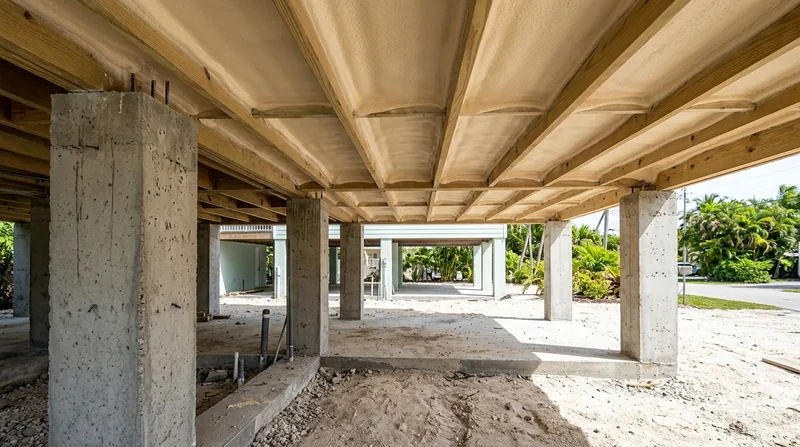
| Elevated Floor and Underside Insulation | Closed-cell foam sprayed under elevated floors in homes raised on pilings or piers, protecting against water intrusion and providing thermal control. | Waterfront properties in Miami Beach, Palmetto Bay, and Cutler Bay that sit above storm surge and king tide zones. |
Closed Cell Spray Foam Insulation Cost in Miami: What to Expect
Closed-cell spray foam typically starts at $1.20 per board foot for standard attic and rim joist work, but the final price depends on several factors specific to your home and location. Attic size, roof deck access, the condition of existing insulation, moisture issues, and the complexity of air sealing all move the cost up or down. A straightforward attic top-up in a 2,000-square-foot home in Doral or Kendall with good access and no moisture problems will run lower than a sealed roof deck retrofit on a 1920s Mediterranean Revival home in Coral Gables with a barrel-tile roof and limited attic space. Metal buildings and condensation-prone spaces in the Redland or Homestead also require site-specific assessment because the square footage and spray thickness vary widely. The best way to get a real number is to request a free written estimate with R-value and thickness specs. We respond within 24 hours at (786) 503-8206 and provide a quote with no obligation to book. See our pricing page for more detail on what moves the cost.
What to Look for When Hiring a Spray Foam Insulation Contractor Near Miami
Closed-cell spray foam is a high-performance product, but only if it is installed correctly. A bad installation costs you money and creates problems that take years to show up. When you are evaluating spray foam contractors near Miami, start by asking for a written estimate with R-value, thickness, and board-foot quantity clearly stated. Any contractor who quotes a price without those specs is guessing, and you should walk away. Ask about their insurance coverage and request a certificate if you need it for your lender or HOA. Verify that they understand the local building code and permitting process at your address, because attic ventilation, ignition barriers, and thermal barrier rules vary from Miami to Homestead to Doral. Get at least two estimates so you can compare approach and price. Ask for references from recent jobs in your neighborhood, and call them. Ask about the re-entry window and what mechanical ventilation they use during curing. The cheapest estimate is rarely the best one. The professional contractor who takes time to assess your space, explains what is required, and provides a clear timeline and written guarantee is the one worth hiring. Call us at (786) 503-8206 to request a free estimate and see the difference a local, experienced shop makes.
Since 2012, Miami Spray Foam Insulation has been the local choice for homeowners, builders, and property managers across Greater Miami who need closed-cell foam installed right the first time. We are fully insured and provide written estimates with no obligation. Call (786) 503-8206 today.
Closed Cell Spray Foam Insulation in Miami: Pricing Guide
| Service | Price | Details |
|---|---|---|
| Attic and Rim Joist Sealing | Starting at $1.20/board ft | Includes closed-cell foam, mechanical ventilation, and re-entry timeline; cost varies by attic size and access |
| Sealed Roof Deck (Unvented Attic) | Starting at $1.50/board ft | Higher density and thickness required; cost depends on roof area, deck condition, and complexity of air sealing |
| Metal Building and Condensation Control | Starting at $1.35/board ft | Interior spray to walls and roof panels; cost determined by building size, steel configuration, and access |
| Elevated Floor and Underside Insulation | On estimate | Waterfront and storm-surge-prone homes require site inspection to assess moisture, water exposure, and spray accessibility |
| Travel and Mobilization | Included | No separate mileage fee or travel charge within Miami and surrounding service areas |
| Free Written Estimate | Free | Includes R-value, thickness, and board-foot quantity; response within 24 hours at (786) 503-8206 |
Indicative pricing, the exact cost depends on square footage, finish, and site access. Free personalized estimate within 24h at (786) 503-8206.


