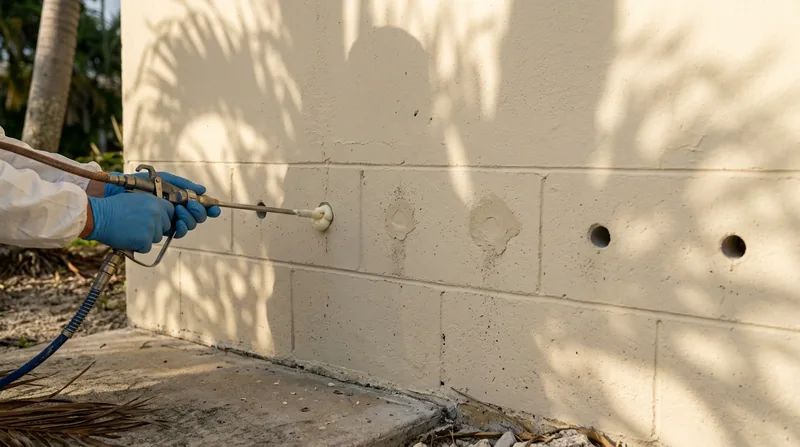




Wall & Injection Foam Insulation in Miami fills the hollow cores of concrete block walls and the furred cavities behind plaster and drywall without tearing into living space. Miami's 1950s-70s concrete block ranches, older Coconut Grove wood-frame homes, and pre-1980 stucco-clad buildings sit with uninsulated or poorly insulated wall cavities that leak heat and humidity year-round. Injection foam reaches into those closed walls through small drilled ports, cures in place, and the ports patch to match the exterior finish. It is the only retrofit that stops wall heat loss without demolition, and in a city where air conditioning runs 365 days a year, it cuts the load on equipment and the dollars flowing to the power company.
Why Wall and Injection Foam Insulation Matters in Miami's Aging Housing Stock
Miami's housing spans from 1920s Mediterranean Revival mansions in Coral Gables to post-hurricane rebuilds in Homestead and Palmetto Bay. The common thread is uninsulated or thin-walled cavities. Concrete block walls conduct heat directly into the home. Older plaster walls over wood framing have no insulation at all. In Miami's tropical climate with vapor drive pushing inward year-round, uninsulated walls mean higher cooling costs, moisture risk, and thermal comfort that swings with the sun. Injection foam fills those voids without opening walls, preserving finishes and avoiding weeks of drywall repair.
- Hollow concrete block walls absorb and radiate heat through the exterior stucco into conditioned space, forcing air handlers to work continuously.
- Furred plaster walls in older homes often have no insulation in the cavity between the plaster and the structural wall.
- Frame walls in Coconut Grove cottages and wood-sided homes leak heat and humidity through every stud bay if they were built before insulation standards tightened.
- Injection foam fills those cavities completely, sealing air leaks and adding R-value without disturbing the interior finish.
- The process takes hours, not weeks, and patches blend with existing stucco or paint.
Uninsulated walls are the hidden energy drain in pre-1980 Miami stock, and injection foam is the only retrofit that addresses it without demolition.
Key info: Miami's building code and the Florida Building Code govern thermal barrier and ignition barrier requirements for foam in walls. Always verify what applies at your specific address with your local building department, whether in Miami, Coral Gables, Hialeah, or Homestead. Permits are not always required for retrofit foam in existing walls, but inspection may be, and the rules vary by city. Check with your local building official before scheduling work.
For more on air sealing and thermal performance, see how sealing air leaks complements insulation retrofit.
How Injection Foam Insulation Works in Miami Walls
Injection foam is a two-part process. First, we locate the wall cavity, drill small access ports (typically 1 to 1.5 inches) into the exterior stucco or interior drywall, and inject low-pressure foam that expands to fill the void. The foam cures in place, bonding to the block, framing, and any existing material inside the cavity. Once cured (typically 24 to 48 hours), we patch the ports to match the surrounding finish. The entire job stays contained inside the wall with no demolition, no temporary walls, and no disruption to occupancy.
- We inspect the wall cavity using borescope or thermal imaging to confirm it is dry and suitable for foam.
- We drill access ports at strategic intervals along the wall, typically spaced 16 to 24 inches apart.
- We inject foam at low pressure, allowing it to expand and fill the cavity completely without forcing existing material.
- We monitor injection pressure and foam rise to ensure even fill and proper density.
- We allow 24 to 48 hours for cure before patching ports with foam-compatible sealant and finish material.
- Port patches are sanded and painted or stuccoed to match the existing wall finish.
The result is a fully insulated wall cavity with no visible evidence of the work once patches cure.
Example: A 1960s concrete block home in Kendall with 2,000 sq ft of exterior wall receives injection foam in all hollow cores. Ports are drilled on the interior, behind furniture, to minimize visibility. Foam fills the 3-inch core, adding R-15 to R-18 depending on foam type. Patches are painted to match interior walls. The job takes two days, and the home's cooling load drops noticeably within a week as the walls stop conducting heat from the exterior.
See our closed-cell spray foam page for details on R-value and moisture control performance in tropical climates.
Injection Foam Methods and Best Uses
| Approach | Description | Best for |
|---|---|---|
| Closed-cell injection foam | Two-part polyurethane injected at low pressure into wall cavities; expands to fill voids and cures solid. | Concrete block walls, furred plaster cavities, frame walls in humid climates; moisture control is the priority. |
| Open-cell injection foam | Lower-density foam injected into cavities; softer texture, slightly lower R-value per inch, allows vapor transmission. | Interior frame walls where vapor permeability is desired; lower cost than closed-cell for insulation-only retrofit. |
| High-pressure injection | Foam injected with controlled pressure to reach deep cavities and ensure complete fill without over-packing. | Large or irregularly shaped voids, block walls with internal obstructions, walls where low-pressure fill leaves gaps. |
| Multiple-port injection | Ports drilled at multiple heights and intervals to ensure foam reaches top, middle, and bottom of the cavity. | Tall walls, walls with internal ledges or ties, any cavity where single-port injection would leave voids. |
Wall & Injection Foam Insulation Cost in Miami: What to Expect
Injection foam insulation for walls typically starts at $2 to $4 per square foot of wall cavity treated, depending on wall type, cavity depth, foam density, and access. A concrete block wall with a 3-inch hollow core costs less per square foot than a furred plaster cavity with 4 to 6 inches of depth. Accessibility matters: walls that are easy to reach from inside cost less than walls requiring exterior scaffolding or interior furniture relocation. The number of access ports, the linear feet of wall being treated, and whether the cavity is clean or contains old insulation all affect the final price. Get written estimates from two or three contractors that specify the wall type, cavity depth, foam type (open or closed-cell), R-value achieved, and the square footage being treated.
- Wall type and cavity depth are the largest cost drivers: concrete block with 3-inch cores is the baseline.
- Furred plaster walls with deeper cavities and irregular geometry cost more per square foot due to complexity.
- Access determines labor: interior ports cost less than exterior drilling through stucco and patching.
- Existing insulation or debris in the cavity may require removal before injection, adding cost.
- Multiple stories or walls on multiple sides of the home increase the total project cost but not the per-square-foot rate.
- Finish patch material (paint, stucco, caulk) is included in the estimate and matched to existing surfaces.
For a detailed breakdown and current pricing for your address in Miami or surrounding areas, visit our pricing page or call (786) 503-8206 for a free written estimate.
Wall & Injection Foam Insulation Near Me: What Miami Homeowners Should Know When Hiring
Choosing the right contractor for injection foam insulation is about verifying insurance, understanding the scope, and confirming that the estimate includes R-value and thickness specifications. Many homeowners mistake a low price for a good deal and end up with incomplete fill, improper curing, or poor patch work. The honest contractor will give you a written estimate with the wall type, cavity dimensions, foam type, expected R-value, and a re-entry timeline of 24 to 48 hours. They will explain whether permits apply at your specific address (rules vary between Miami, Hialeah, Coral Gables, and Homestead), and they will not promise work until they inspect the wall in person.
- Verify that the contractor carries full insurance and can provide a current certificate of insurance.
- Ask for references from three recent jobs in your neighborhood or with similar wall types.
- Get written estimates from at least two contractors that specify foam type, R-value per inch, wall cavity depth, and total square footage.
- Confirm that the estimate includes all drilling, injection, curing time (24 to 48 hours), and patch materials.
- Ask about permitting: the contractor should tell you whether permits apply at your address and defer to your local building department.
- Check whether your HOA has rules about exterior work (drilling through stucco) even though insulation itself is rarely restricted.
- Request a walkthrough after cure to inspect patches and confirm they match the surrounding wall finish.
A contractor who avoids these details, quotes a price with no specification, or promises immediate re-entry is not the one to hire. Contact us at our contact page or call (786) 503-8206 to schedule a free estimate with full specifications.
Wall & Injection Foam Insulation in Miami: Pricing Guide
| Service | Price | Details |
|---|---|---|
| Concrete block wall injection (3-inch core) | Starting at $2/sq ft | Hollow-core concrete block filled with closed-cell foam, ports drilled on interior, patches painted to match |
| Furred plaster or drywall cavity (4-6 inch depth) | Starting at $3/sq ft | Deeper cavities, irregular geometry, and finish complexity add labor; open or closed-cell foam options available |
| Frame wall retrofit (wood-frame homes) | Starting at $2.50/sq ft | Older Coconut Grove and Miami Shores wood-frame walls; accessibility and stud spacing affect final cost |
| Large or complex wall projects | On estimate | Multi-story homes, exterior scaffolding required, existing insulation removal, or unusual cavity geometry require site inspection |
| Estimate | Free | Written estimate with R-value, thickness, and square footage; response within 24 hours at (786) 503-8206 |
Indicative pricing, the exact cost depends on square footage, finish, and site access. Free personalized estimate within 24h at (786) 503-8206.


