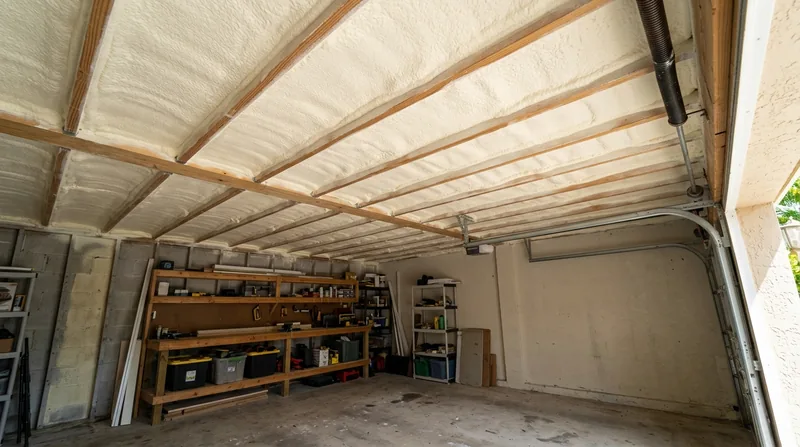




Garage spray foam insulation in Miami transforms a storage oven into usable square footage while sealing the radiant heat that bleeds through garage ceilings into bonus rooms above. Miami's garage spaces sit exposed to the brutal tropical sun year-round, with temperatures climbing to 140 to 160 degrees Fahrenheit in the attic space directly overhead. When a bonus room, home office, or workshop sits above that garage, the concrete block walls and thin wood framing conduct that heat straight downward, making the upper space uncomfortable and expensive to cool. Spray foam insulation and air sealing on the garage ceiling and shared walls stops that thermal bleed at the source, creating a genuine thermal break between conditioned space and the garage cavity. This is not a cosmetic upgrade, it is the difference between a storage box and a room you can actually occupy during a Miami summer.
Why Garage Spray Foam Insulation Matters in Miami's Two-Story Stock
Greater Miami's 1980s and 2000s residential boom built two-story homes with bonus rooms cantilevered over attached garages. These garages sit uninsulated and unconditioned, directly below living space that is supposed to be air-conditioned. The attic above the garage runs at 140 to 160 degrees Fahrenheit most of the year, and the garage itself absorbs that heat from the roof and walls. Without foam sealing on the garage ceiling, that temperature gradient radiates straight up into the bonus room, forcing the AC to work continuously against a moving target. Spray foam stops the leak cold, seals all the penetrations where ductwork and electrical runs pass through the ceiling plane, and creates a continuous thermal barrier that blown-in insulation cannot match.
- We spray closed-cell or open-cell foam directly onto the garage ceiling to block radiant heat and create an air seal against the conditioned space above.
- We seal all electrical outlets, light fixtures, HVAC penetrations, and rim joist connections where the garage walls meet the house frame.
- We insulate shared walls between the garage and living areas to prevent temperature bleed through concrete block and wood studs.
- We apply a thermal barrier (required by code) that meets the fifteen-minute fire rating for any garage space connected to a residence.
- We handle permitted garage conversions and home workshops with the same care, treating the space as conditioned square footage from day one.
The result is a garage ceiling that stops acting as a radiator and starts acting as an insulation layer, cutting the cooling load on the bonus room and making the space livable in summer.
Key info: A garage in Pembroke Pines or Miramar with a bonus room overhead will see the ceiling temperature drop from 135°F to under 85°F after spray foam sealing, cutting the AC runtime on that floor by 30 to 40 percent. That difference is the difference between a room you can use and a room you avoid in summer.
For more detail on how we handle sealed spaces and thermal barriers, see our attic spray foam insulation service and air sealing guide.
How We Insulate Garage Ceilings in Miami: The Process
Garage ceiling foam starts with a site walkthrough to measure the square footage, identify all penetrations (ductwork, electrical, gas lines, plumbing), and determine whether the existing framing will accept spray foam without modification. We check for active leaks, moisture damage, or mold, if we find any, we address the water source first or we walk away. Once the space is dry and safe, we lay out the work, establish a re-entry window of twenty-four to forty-eight hours, and set up mechanical ventilation to manage cure gases during and after the spray.
- We inspect the garage ceiling framing, roof deck, and all penetrations to confirm the substrate is sound and dry.
- We seal air leaks around electrical outlets, light fixtures, and HVAC ductwork with foam before or during the main spray.
- We apply closed-cell or open-cell foam to the specified R-value and thickness, measured and confirmed on site with written documentation.
- We install a thermal barrier (intumescent paint or a code-approved membrane) that meets the fifteen-minute fire rating required by Miami-Dade and Broward building codes.
- We ventilate the garage mechanically during cure and establish a clear re-entry window so you know when the space is safe to occupy again.
The entire process typically takes one day for a standard two-car garage ceiling, with cure and full occupancy clearance within two days.
Example: A Kendall home with a bonus room over a two-car garage received closed-cell foam on the ceiling (R-21 at 3.5 inches), foam around the garage-side HVAC return air plenum, and a thermal barrier coat. Total job took four hours. The bonus room went from 92°F to 78°F during peak afternoon heat, and the homeowner's AC bill dropped $40 to $60 per month.
See closed-cell spray foam insulation and open-cell spray foam insulation for detailed comparisons of foam types for garage and bonus room applications.
Garage Ceiling Foam Methods: Closed Cell vs. Open Cell
| Approach | Description | Best for |
|---|---|---|
| Closed-Cell Foam | High-density foam (R-6 per inch) that creates an air and vapor barrier, blocking radiant heat and moisture. Requires spray equipment and trained application. | Garage ceilings under bonus rooms where radiant heat is the dominant problem and vapor control matters. |
| Open-Cell Foam | Lower-density foam (R-3.5 per inch) that insulates and dampens sound but is vapor-permeable. Costs less per board foot and is easier to trim. | Garage workshops where sound control and cost are priorities and vapor drive is not a concern. |
| Foam Plus Blown-In Retrofit | Spray 2 to 3 inches of foam for air sealing and thermal break, then add blown-in cellulose or fiberglass for bulk R-value at lower cost. | Garages where R-value is the goal and air sealing plus cost control are both important. |
| Shared Wall Insulation | Closed-cell or open-cell foam injected into hollow concrete block or cavities in wood-frame walls shared with the house, sealing all voids. | Garage walls attached to living space where the wall cavity is hollow and inaccessible without demolition. |
Garage Spray Foam Insulation Cost in Miami: What to Expect
Garage ceiling foam in Miami typically starts at $1,200 for a standard two-car garage (approximately 400 to 500 square feet of ceiling) with closed-cell foam at R-21 thickness and a thermal barrier coat included. The price moves up based on the square footage of the ceiling, the foam type (closed-cell or open-cell), the R-value specification, the number and complexity of penetrations, and whether shared walls also need sealing. A garage with multiple HVAC returns, electrical runs, and plumbing penetrations will cost more than a simple slab garage with a clear ceiling plane. If the existing ceiling has failed insulation that must be removed first, add the cost of insulation removal to the estimate.
We provide a written estimate with R-value, thickness, board-foot quantity, and labor broken out clearly. That estimate is free and carries no obligation. The best practice is to get two or three estimates from different shops so you can compare specifications, not just price. A bid with no R-value and no thickness specification is a red flag, that contractor cannot tell you what they are actually installing.
For a full pricing overview and financing options, see our pricing page. Call us at (786) 503-8206 for a free estimate on your garage ceiling.
Garage Spray Foam Insulation Near Me: What Miami Homeowners Should Know When Hiring
Hiring a spray foam contractor for your garage ceiling is a straightforward process, but there are real differences between shops that matter. Start by asking any contractor for proof of insurance (general liability and workers compensation) and get the name of their insurer so you can verify the policy is active. Ask for references from recent garage or bonus room jobs in Miami or nearby areas, and call at least two of them to ask about the cure window, whether the space was usable within the stated timeframe, and whether they would hire the same contractor again.
Ask for a written estimate that includes the foam type, R-value per inch, total thickness, board-foot quantity, thermal barrier specification, and labor cost. If a contractor promises immediate re-entry or says the space will be ready to use the same day, walk away, the cure window for spray foam is twenty-four to forty-eight hours minimum, and anyone who promises faster is either lying or skipping ventilation. Ask whether they will provide mechanical ventilation during cure and what the re-entry protocol is. Confirm that the estimate includes a thermal barrier (required by code for any garage connected to a house) and get the specific product name in writing.
If your garage is in an HOA community (common in Doral, Coral Gables, or Weston), check whether architectural review is required for any exterior work or modifications to the garage structure. Most HOA rules do not govern insulation work, but some do govern external vents or modifications to the roof line, so verify before you book. Permitting for garage insulation and thermal barrier application varies by city, Miami-Dade, Broward, and each municipality have their own building department and code officials. We help you navigate what applies at your address, but the final call rests with your local building department.
For a free estimate and a conversation about your specific garage, contact us or call (786) 503-8206.
Garage Spray Foam Insulation in Miami: Pricing Guide
| Service | Price | Details |
|---|---|---|
| Standard Two-Car Garage Ceiling | Starting at $1,200 | Closed-cell foam, R-21 at 3.5 inches, thermal barrier coat included, 400 to 500 sq ft |
| Garage Ceiling Plus Shared Walls | Starting at $1,800 | Ceiling foam plus hollow concrete block walls sealed with injection or spray foam, typical three-wall perimeter |
| Open-Cell Garage Ceiling (Sound Control) | Starting at $900 | Open-cell foam for acoustic dampening and cost savings, R-3.5 per inch, thermal barrier, 400 to 500 sq ft |
| Garage Insulation Removal and Replacement | On estimate | Cost depends on existing insulation type, condition, and disposal; combined removal and new foam spray quoted together |
| Travel and Estimate | Free estimate | No charge for on-site walkthrough, measurement, and written specification; response within 24 hours at (786) 503-8206 |
Indicative pricing, the exact cost depends on square footage, finish, and site access. Free personalized estimate within 24h at (786) 503-8206.


