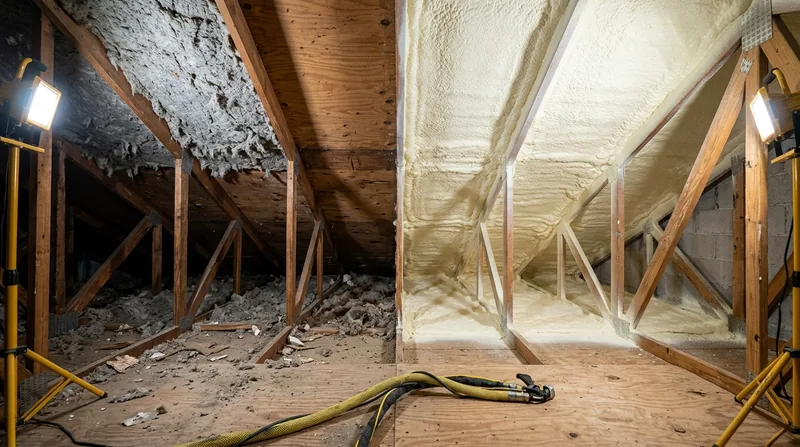




Miami's tropical climate and unique building stock create persistent insulation challenges that demand a full reset rather than a patch. Homes across Greater Miami sit on concrete slabs with low wood-truss attics running AC ductwork at 140 to 160 degrees Fahrenheit for most of the year, while older Mediterranean Revival homes in Coral Gables and Miami Shores carry barrel-tile roofs with minimal attic space, and post-Andrew 1992 construction in Homestead and Cutler Bay sits under code-mandated hurricane straps on every truss. When existing fiberglass batts flatten, rat droppings contaminate the substrate, or a roof leak saturates the material during hurricane season, insulation replacement and re-insulation becomes the only honest solution. We remove the failed material completely, air-seal the gaps that let conditioned air escape, and install new foam to current code R-values so your cooling system works as intended instead of fighting a leaking attic. The work is straightforward but exacting, and it transforms the thermal and moisture performance of the space.
Why Insulation Replacement Matters in Miami's Heat and Humidity
Miami's year-round heat and inward vapor drive mean that old, flattened, or contaminated insulation does not simply underperform. It actively leaks conditioned air into an unconditioned attic, forcing your AC to run longer and hotter while humidity wicks into the cooler foam and fiberglass below, creating the exact conditions for mold and rot. Hurricane season brings roof leaks that soak the substrate in a single afternoon, and the combination of heat, moisture, and standing water makes the attic uninhabitable within days. Rat infestations are endemic in South Florida; once rodents nest in insulation, the material is fouled beyond cleaning and must be removed entirely.
- Flattened fiberglass loses R-value and allows hot attic air to bypass the material entirely into the living space below.
- Rat droppings and urine contaminate insulation and create biohazard conditions that require professional removal and disposal.
- Roof leaks during hurricane season soak insulation, destroy its thermal resistance, and trap moisture that feeds mold and wood decay.
- New roofs often require attic access and substrate inspection, making a full insulation reset the logical concurrent project.
- Older homes with thin or missing attic fill were built before modern energy codes and cannot meet current thermal or air-sealing standards without replacement.
A full replacement addresses all of these failure modes at once and delivers an attic that performs to code instead of working against your cooling system.
Key info: Miami's concrete-block ranches built in the 1950s and 1960s across Westchester, Hialeah, and Kendall often have hollow-block walls with minimal insulation and flattened attic fill. When a homeowner adds central AC or upgrades cooling capacity, the undersized thermal envelope becomes a liability, and replacement foam with proper air sealing brings the attic into alignment with the system's capacity.
For more detail on the full scope of attic work, see Attic Spray Foam Insulation in Miami.
How Insulation Replacement Works in Miami: The Full Process
Replacement is a three-phase job: removal and disposal of the old material, air sealing and substrate preparation, and installation of new foam to code R-values. We do not spray over flattened, contaminated, or wet insulation. If the attic has standing water, active roof leaks, or structural damage, those issues are fixed first or we walk away. Once the substrate is dry and clean, we seal rim board gaps, electrical chases, HVAC penetrations, and other air leaks that would let conditioned air bypass the new foam, then spray closed-cell or open-cell foam to the thickness and R-value required by code at your address.
- We remove all old insulation, dispose of it properly, and leave the attic deck clear and ready for inspection.
- We inspect the roof deck, rafters, and structural members for damage or rot and flag any issues that need repair before foam is applied.
- We seal gaps around electrical boxes, HVAC ducts, plumbing vents, and other penetrations that act as air leaks in an unconditioned attic.
- We apply new closed-cell or open-cell foam in controlled passes to the thickness specified by code, with mechanical ventilation running during cure.
- We install thermal and ignition barriers as required by code at your address and confirm all work with a final walkthrough and written estimate showing R-value and thickness.
The entire process typically takes two to three days depending on attic size, old material removal complexity, and cure time between passes.
Local example: A Coral Gables Mediterranean Revival home with a barrel-tile roof and minimal attic had fiberglass batts that were compressed and soaked by a roof leak during the 2023 hurricane season. The old material was removed, the leak was patched, the attic was dried, and closed-cell foam was sprayed to R-38 with proper thermal barriers. The attic is now sealed, the roof deck is protected from future moisture, and the cooling system performs as designed.
Learn more about Insulation Removal in Miami and the first step of the replacement process.
Replacement Methods and Foam Types
| Approach | Description | Best For |
|---|---|---|
| Closed-cell spray foam replacement | Dense foam with high R-value per inch (R-6.5 to R-7), excellent vapor resistance, and air sealing in one pass. Requires mechanical ventilation during cure and thermal barrier application. | Attics with roof leaks, high humidity, or prior rat damage. Homeowners prioritizing maximum thermal performance and moisture control in a tight space. |
| Open-cell spray foam replacement | Lower-density foam with R-value around R-3.5 per inch, permeable to vapor, and excellent sound dampening. Requires more thickness for the same R-value but is lower cost and easier to install around obstructions. | Attics with good ventilation, no prior water damage, and homeowners seeking a budget-friendly alternative to closed-cell with acceptable performance. |
| Blown-in mineral fiber top-up | Loose-fill cellulose or mineral wool added over existing sound substrate to reach target R-value without full removal. No air sealing, no vapor barrier, but lowest cost for marginal R-value gains. | Existing attics with sound substrate and only minor settling. Not a replacement in the true sense, only a supplement if the old material is not contaminated or wet. |
| Full removal and closed-cell retrofit | Complete tear-out of old material, air sealing all penetrations, and closed-cell spray foam to code R-value. Highest cost but delivers sealed attic, moisture control, and maximum durability in Miami's climate. | Post-hurricane damage, rat infestation, prior roof leaks, or homes where the attic is treated as conditioned space and needs full thermal and air-sealing performance. |
Insulation Replacement and Re-Insulation Cost in Miami: What to Expect
Insulation replacement pricing in Miami depends on attic size, the volume of old material to remove and dispose of, the condition of the substrate, and whether you choose closed-cell or open-cell foam. A straightforward replacement in a 1,200 square-foot attic with accessible rim board and no structural damage typically starts at $2,800 to $3,500 for open-cell foam, and $4,200 to $5,800 for closed-cell. Attics with prior water damage, rat contamination, or difficult access cost more because removal and substrate prep take longer. New roofs, structural repairs, or extensive air sealing can push the job into the $6,000 to $8,500 range. The only way to know what your home requires is a free on-site estimate where we measure the space, assess the substrate, and quote R-value and thickness in writing.
Several factors move the price up or down. Attic size is the primary driver: a 2,000 square-foot attic costs roughly 60 percent more than a 1,200 square-foot space. Old material disposal fees apply if the attic contains contaminated fiberglass or rat-fouled insulation. Structural damage or roof leaks that require repair before foam can be applied add to the scope. Tight or blocked access, low eaves, or ductwork that limits spray patterns increase labor time. Homes in hurricane zones like Homestead or Cutler Bay may require additional air sealing around roof-to-wall connections, which adds cost but is essential for structural integrity.
We provide a written estimate with R-value, thickness, and labor detail so you know exactly what you are paying for. Get full pricing information and examples for your specific job size and foam type.
What to Look for When Hiring an Insulation Replacement Contractor Near Me in Miami
Insulation replacement is not a commodity service, and the difference between a competent contractor and a cut-rate operator shows up in the details: a written estimate with R-value and thickness specs, mechanical ventilation during cure, a clear re-entry window of 24 to 48 hours, and the willingness to walk away from a wet or contaminated substrate. When you call a spray foam contractor near you in Miami, ask three questions before you get a price. First, will they remove and dispose of the old insulation, or will they spray over it? Second, do they provide a written estimate showing R-value and foam thickness, or just a lump number? Third, what is their process for ensuring the substrate is dry and clean before foam is applied?
- Request a written estimate with R-value, thickness, and labor itemized separately so you can compare apples to apples across contractors.
- Verify that the contractor is fully insured and ask to see a certificate of insurance naming your address as additional insured.
- Check references from recent jobs in your city or neighborhood, and ask those homeowners about the contractor's responsiveness after the job was done.
- Confirm that the contractor understands the permit and thermal barrier requirements that apply at your specific address in Miami or your city.
- Ask whether they handle their own removal and disposal or subcontract it, and whether disposal costs are included in the estimate or billed separately.
- Verify that the contractor will not spray over wet insulation or a leaking roof, and will not promise immediate re-entry if cure time has not elapsed.
The best contractors in Miami are the ones who know the local building code, understand the failure modes that dominate in South Florida, and are willing to walk away from a job that is not set up for success. Call us at (786) 503-8206 or request a free estimate and we will show you the difference between a professional replacement and a quick spray.
Ready to replace your insulation? Call Miami Spray Foam Insulation at (786) 503-8206 for a free, no-obligation estimate. We serve Miami, Miami Beach, Coral Gables, Hialeah, Homestead, Doral, Kendall, Miami Gardens, and all surrounding areas. Response within 24 hours.
Insulation Replacement & Re-Insulation in Miami: Pricing Guide
| Service | Price | Details |
|---|---|---|
| Open-cell foam replacement, small attic | Starting at $2,800 | Includes removal of old material, air sealing, and open-cell foam to code R-value in attics under 1,200 square feet with accessible substrate |
| Closed-cell foam replacement, standard attic | Starting at $4,200 | Full removal, substrate prep, air sealing, and closed-cell foam to R-38 or R-49 in 1,200 to 1,800 square feet with good access |
| Replacement with prior water damage or contamination | Starting at $5,200 | Includes hazmat-grade removal and disposal, substrate drying, structural inspection, and closed-cell foam installation with full air sealing |
| Large attic or complex scope | On estimate | Attics over 2,000 square feet, multiple levels, prior roof damage, or structural repairs require on-site measurement and detailed quote |
| Travel and consultation | Included | No mileage fee or call-out charge in Miami and surrounding service areas, free estimate response within 24 hours |
| Estimate | Free | Written proposal with R-value, thickness, and labor itemized, no obligation to book, (786) 503-8206 |
Indicative pricing, the exact cost depends on square footage, finish, and site access. Free personalized estimate within 24h at (786) 503-8206.


