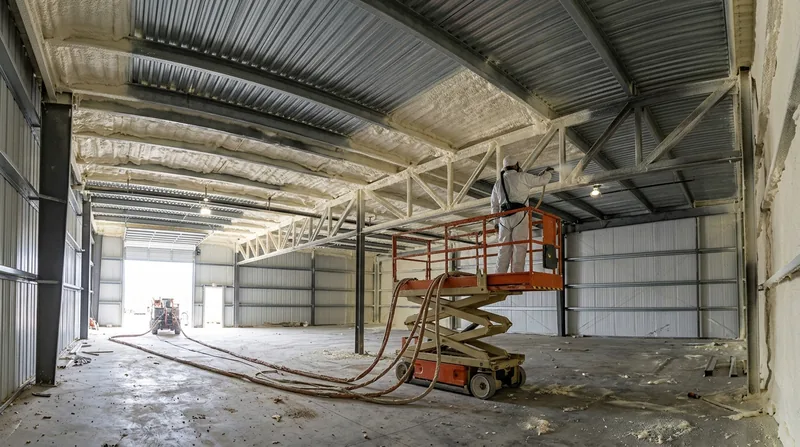




Commercial & New Construction Spray Foam in Miami serves warehouses, offices, production facilities and new-build shells across the Doral-to-Medley industrial belt and throughout Greater Miami. The tropical climate, year-round heat and humidity, and the region's flat terrain with concrete-slab construction mean that thermal control and moisture management are not seasonal luxuries but operational necessities. New construction demands code-compliant assemblies that Miami-Dade and Broward building inspectors will accept without pushback. Phased work keeps your operation running while we spray. We have served commercial builders and facility managers since 2012, and we document every job to the R-value and thickness your inspector requires.
Why Commercial & New Construction Spray Foam Matters in Miami's Industrial and Build-to-Suit Market
Miami's commercial real estate spans three distinct zones: the Doral and Medley industrial belt west of the airport, where warehouses and production buildings drip with condensation without closed-cell foam; the downtown and Brickell office towers under flat roofs with minimal attic space; and the suburban office parks and retail shells in Kendall, Hialeah and Miami Gardens. New construction under current energy code requires thermal barriers and ignition barriers, and the building official at your city or county will enforce them. Existing commercial buildings often carry outdated or failed insulation, and retrofit work must be scheduled without shutting down operations.
- We spray closed-cell foam on metal building shells to stop condensation and thermal loss in one pass, keeping your production floor dry and climate-controlled year-round.
- We work phased schedules on occupied buildings, sectioning the work so your business continues operating while we insulate one zone at a time.
- We provide written estimates with R-value and thickness specifications that match your local building code and satisfy your inspector's review before the job starts.
- We remove and replace failed insulation in warehouses and commercial attics without contaminating your operation or leaving debris behind.
- We seal air leaks around ductwork, electrical penetrations and structural seams so your HVAC load drops and your building envelope stays tight.
Code-compliant documentation and predictable scheduling are what separate a professional spray foam job from a rig-and-run crew that disappears when the smell will not go away.
Key info: Miami-Dade and Broward building codes govern thermal barriers, ignition barriers and R-value minimums for attics and sealed assemblies. We help you understand what applies at your address, and we document every job so your inspector has what they need. Verify permitting and registration requirements with your local building department before work begins.
For more on how spray foam performs in sealed assemblies, see our closed-cell spray foam insulation page.
Florida statute and administrative code set the standards for contractor work on commercial property. You can verify requirements with your city or county building department or the Florida Department of Business and Professional Regulation.
How We Handle Commercial & New Construction Spray Foam Projects in Miami
Commercial spray foam work demands scheduling precision, code compliance and a crew that understands occupied-building protocols. We begin with an on-site assessment of your building envelope, existing insulation condition, and mechanical systems. We then provide a written estimate that names the R-value, foam thickness, the assembly type (open cell, closed cell, or hybrid), and the timeline. Once approved, we coordinate with your facility manager to schedule work in phases that keep your operation running.
- We inspect the building shell, roof deck, wall cavities or metal structure and identify any moisture, leaks or contamination that must be addressed before foam is applied.
- We provide a written estimate naming the R-value, thickness, foam type and schedule, and explaining any permits or inspections your city requires.
- We schedule the work in phases or off-hours so your business continues operating and your staff is not displaced.
- We set up mechanical ventilation during cure and enforce a re-entry window of 24 to 48 hours before the space is occupied.
- We clean up all debris and packaging, and we provide documentation for your building records and future insurance or resale.
Phased scheduling and transparent communication are what make a commercial job successful.
Example: A warehouse in Medley with a metal roof and exposed trusses needed closed-cell foam to control condensation on the steel structure. We scheduled the work in two night shifts so the facility could operate during the day. The foam cured under mechanical ventilation, and the building was re-entered after 36 hours. The owner saw no moisture on the roof deck within two weeks of completion.
For a detailed look at insulation removal and replacement, see our insulation removal page.
Commercial & New Construction Spray Foam Methods and Applications
| Approach | Description | Best for |
|---|---|---|
| Closed-Cell Foam on Metal Buildings | High-density foam (3.5 to 4.5 lbs/cubic foot) sprayed to 3 to 6 inches on roof decks and exterior walls. R-value 6.0 to 7.0 per inch. Vapor-impermeable, stops condensation and air infiltration in one pass. | Warehouses, barns, production buildings and metal-frame structures in humid climates where condensation is the failure mode. |
| Closed-Cell Foam in Sealed Roof Decks | Foam sprayed directly to the underside of the roof deck (unvented assembly). Creates a continuous thermal and air barrier. R-value 6.0 to 7.0 per inch. Mechanical ventilation required during cure. | New construction and retrofits where attic ventilation is not feasible or where the roof deck itself must be the thermal boundary. |
| Open-Cell Foam in New Attics | Low-density foam (0.5 to 1.5 lbs/cubic foot) sprayed to 5 to 8 inches between roof trusses. R-value 3.5 to 4.0 per inch. Vapor-permeable, cost-friendly, allows attic ventilation if needed. | Budget-conscious new construction and retrofit attics where condensation is not the primary concern and soffit ventilation can remain active. |
| Injection Foam in Existing Walls | Closed-cell foam injected into hollow concrete block or wood-frame wall cavities via small drilled ports. No demolition. Fills cavities completely and stops air leakage. | Retrofit of pre-1980 concrete-block office buildings and commercial shells where wall insulation is needed without exterior or interior demolition. |
Commercial & New Construction Spray Foam Cost in Miami: What to Expect
The cost of commercial spray foam insulation in Miami depends on the building size, the foam type (closed cell or open cell), the assembly type (roof deck, walls, or metal structure), existing insulation removal, and access conditions. Warehouses and metal buildings typically require closed-cell foam to manage condensation, which is more expensive per board foot than open cell but delivers the moisture control that open cell cannot. New construction with straightforward roof-deck access is faster and cheaper than retrofitting an occupied office building with phased scheduling. We provide a free commercial estimate on site, where we measure the square footage, assess any existing insulation or moisture, and quote a price range based on the foam type and thickness your code requires.
Factors that move the cost up or down include the size of the building envelope, the presence of existing insulation that must be removed, the condition of the substrate (wet, contaminated or leaking surfaces require repair before foam is applied), and the logistics of working around occupied spaces or active production. A metal warehouse in Doral with a clear 8,000-square-foot roof deck and no existing insulation will cost less per square foot than a retrofit of an occupied office building in Brickell where we must work in phases and coordinate with your facility manager. Access also matters: a building with a flat roof and no obstructions is faster and cheaper to spray than one with skylights, HVAC units, or other roof penetrations that require careful masking.
We recommend getting 2 to 3 estimates from different contractors so you can compare the R-value, thickness, foam type and timeline. Ask each contractor to specify the R-value and thickness in writing, and to explain why they chose that assembly for your building. Avoid any estimate that quotes a price per square foot without naming the foam type or R-value, or that promises immediate re-entry without mechanical ventilation during cure. Our estimate includes a detailed breakdown and a timeline so you know what to expect before we start.
For a full pricing overview and to request your free commercial estimate, visit our pricing page or call us at (786) 503-8206.
What to Look for When Hiring a Spray Foam Contractor Near Miami
Hiring a spray foam insulation contractor is a decision that affects your building's thermal performance, air quality and code compliance for years. The spray foam market in Miami includes local independent shops, national franchises and rig-and-run crews from out of state. The local independent with a Miami address, local plates and a track record since 2012 is positioned to understand your building's specific needs and to stand behind the work. The national franchise offers brand recognition but may not be familiar with Miami-Dade or Broward permitting. The out-of-state crew sprays the job in an afternoon and disappears; when the smell will not go away or the foam fails, nobody is reachable.
When you call a contractor, ask for the following:
- A written estimate that names the foam type, R-value per inch, thickness in inches, total board feet, and the timeline for completion and re-entry.
- Proof of full insurance coverage and the ability to provide a certificate of insurance before work begins.
- References from at least two commercial or new-construction projects completed in the past two years.
- An explanation of how the contractor will manage mechanical ventilation during cure and what the re-entry window is (typically 24 to 48 hours).
- Clarity on who handles permitting: whether the contractor helps you navigate what applies at your address or whether you are responsible for pulling permits yourself.
- A written warranty on the workmanship, typically one to three years, and the manufacturer's system warranty if one applies to the foam product.
Verify the contractor's track record and insurance before signing a contract. Ask your local building department whether permits are required for the assembly type and foam thickness at your address. Check with your HOA or property management if your building is in a master-planned area, as some HOAs govern exterior work on metal buildings. Call us at (786) 503-8206 or visit our contact page to request a free estimate and to speak with someone who knows Miami commercial construction firsthand.
Commercial & New Construction Spray Foam in Miami: Pricing Guide
| Service | Price | Details |
|---|---|---|
| Free commercial estimate | Free | On-site assessment, R-value and thickness specs, timeline, no obligation to book |
| Closed-cell foam on metal buildings | Starting at $1.50 to $2.50 per board foot | Condensation control on warehouse and production facility roofs and walls, 3 to 6 inches |
| Closed-cell foam in sealed roof decks | Starting at $1.75 to $2.75 per board foot | New construction and retrofit attics, unvented assembly, 4 to 8 inches, code-compliant documentation |
| Open-cell foam in new attics | Starting at $0.75 to $1.25 per board foot | Budget-friendly attic insulation, 5 to 8 inches, allows ventilation, suitable for new construction |
| Injection foam in existing walls | Starting at $2.00 to $3.00 per board foot | Retrofit of concrete-block or wood-frame cavities, no demolition, labor-intensive, small holes drilled and filled |
| Insulation removal and replacement | On estimate | Cost depends on volume of existing insulation, disposal fees, and substrate condition before foam application |
Indicative pricing, the exact cost depends on square footage, finish, and site access. Free personalized estimate within 24h at (786) 503-8206.


