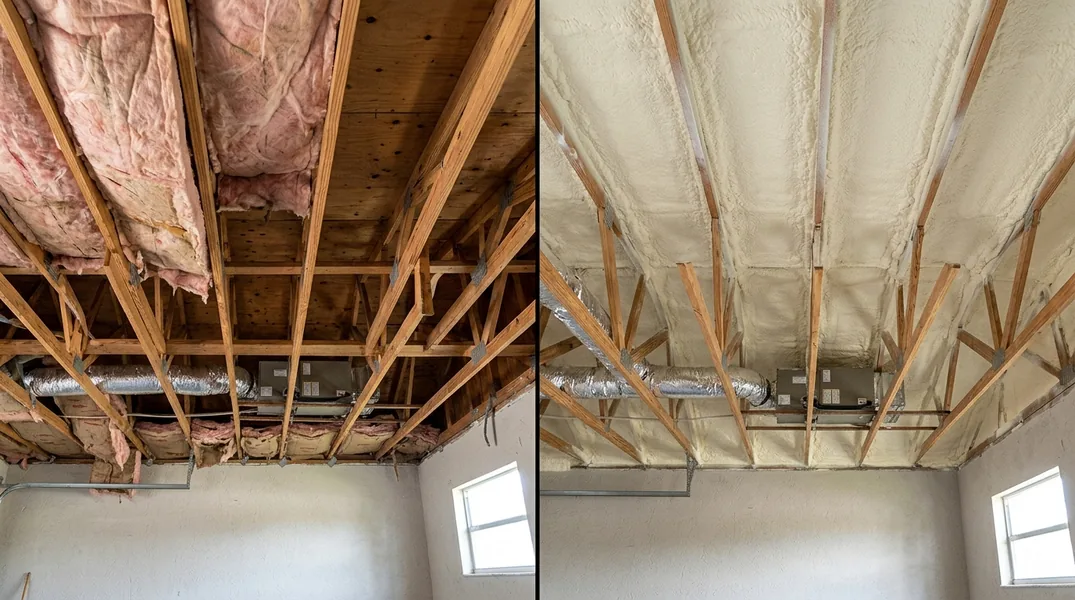
Why South Florida Humidity Is Your Attic's Worst Enemy
Miami sits in one of the most humid regions in the United States. Year-round moisture, afternoon thunderstorms, and the Atlantic Ocean combine to create an environment where attics face relentless moisture pressure. While many homeowners focus on cooling costs and energy efficiency, few realize that humidity control is equally critical to protecting their investment and family health.
When warm, humid air enters your attic through ventilation gaps, soffit vents, or air leaks, it encounters cooler surfaces. This temperature difference causes condensation to form on wooden beams, insulation, and metal ducts. Over time, this moisture accumulation leads to wood rot, mold growth, and structural damage that can cost tens of thousands of dollars to repair. Traditional insulation materials like fiberglass batts absorb moisture like a sponge, making the problem worse rather than better. This is where modern spray foam solutions become essential for Miami Beach and surrounding communities facing intense humidity challenges.
Understanding the Spray Foam Moisture Barrier Advantage
A spray foam moisture barrier works fundamentally differently from traditional vapor barriers or insulation materials. When properly installed, spray foam creates a continuous, seamless seal that blocks humid air from entering your attic in the first place. This preventative approach is far more effective than trying to manage moisture after it has already infiltrated your insulation and structural cavities. The key lies in understanding that the best moisture control strategy is air sealing combined with insulation in one application.
Closed Cell Spray Foam Insulation is particularly effective in humid climates because it has an extremely low permeability rating. This means water vapor cannot easily pass through the material. Additionally, closed cell foam does not absorb moisture the way open cell foam or fiberglass does. When applied to attic surfaces, it creates what building scientists call an air barrier and vapor retarder in one product. This dual functionality is why Miami Spray Foam Insulation recommends closed cell foam for attics in South Florida, where condensation in attic spaces poses a genuine threat to home durability.
The spray foam moisture barrier also eliminates the gaps and seams found in traditional vapor barriers. Plastic sheeting or kraft paper vapor barriers are only effective if installed perfectly with all seams taped and sealed. In practice, these barriers often fail because installers miss small gaps or because homeowners inadvertently puncture them during storage or maintenance. Spray foam, by contrast, fills every cavity, corner, and crevice, leaving no pathway for humid air to bypass the protection.
Closed Cell Spray Foam vs. Open Cell: Which Controls Moisture Better?
Both closed cell and open cell spray foams improve insulation performance, but their moisture management properties differ significantly. Closed cell foam has a density of approximately 1.5 to 2 pounds per cubic foot and contains tiny, completely enclosed cells. This structure creates a vapor barrier that resists moisture transmission. Open cell foam, by contrast, has a density of around 0.5 pounds per cubic foot and contains cells that are interconnected. While open cell foam is less expensive and offers excellent acoustic dampening, it is permeable to water vapor and can absorb moisture if exposed to high humidity over time.
For Coral Gables homeowners dealing with attic moisture problems, closed cell spray foam is the superior choice. Its moisture resistance rating makes it ideal for preventing condensation in attic spaces where temperature fluctuations are common. When warm, humid outside air meets the cooler underside of your roof during early morning hours, closed cell foam prevents that moisture from penetrating into the insulation layer where it would accumulate and cause damage. Open cell foam can still be valuable in other applications, but for attic moisture control in South Florida, closed cell is the industry standard recommendation.
The cost difference between closed cell and open cell foam is notable, but the long-term protection justifies the investment. Moisture-related damage to attic framing, decking, and insulation can easily exceed the cost of premium closed cell installation. When you factor in potential mold remediation, structural repairs, and health risks associated with mold exposure, the decision becomes clear. Miami Spray Foam Insulation helps homeowners understand this value proposition during the consultation process.
How Condensation in Attic Spaces Develops and Spreads
Condensation in attic spaces follows a predictable pattern in South Florida's climate. During the day, your air conditioning system cools your home, and cool air naturally wants to migrate upward through ceiling gaps, light fixtures, and penetrations. At night, when outdoor temperatures drop slightly, the air in your attic cools as well. However, if warm, humid air from your living spaces has entered the attic through air leaks, that moisture-laden air will condense on cooler surfaces like roof decking, metal ducts, and wooden framing. This cycle repeats daily, and moisture accumulates over weeks and months.
The problem intensifies during South Florida's rainy season when outdoor humidity levels can exceed 90 percent for extended periods. Even if your home is well-sealed, moisture finds its way through minor gaps around roof penetrations, soffit vents, and ridge vents. Once moisture accumulates in an attic, it creates an ideal environment for mold and mildew growth. Wood-destroying insects like termites and carpenter ants are also attracted to moisture-damaged wood, creating a cascade of problems that extend far beyond simple insulation concerns.
Proper attic moisture control requires addressing both air leakage and vapor transmission. This is why professional installation of Attic Spray Foam Insulation is so important. By sealing air leaks and creating a vapor-resistant barrier simultaneously, spray foam tackles the root causes of condensation rather than just treating the symptoms. Homeowners who have experienced attic moisture problems often wish they had invested in spray foam earlier, before mold and structural damage required expensive remediation.
Professional Installation: Why DIY Spray Foam Falls Short in Miami
While spray foam insulation is available for consumer purchase, professional installation is strongly recommended for attic applications, especially in Miami's challenging humidity environment. Proper spray foam installation requires precise equipment calibration, correct application temperature and humidity conditions, and expert knowledge of building codes and best practices. When applied incorrectly, spray foam can fail to create an effective moisture barrier, leaving gaps that allow humid air to bypass the insulation entirely. Additionally, improper application can create excessive pressure that damages roof decking or creates safety hazards.
Professional installers from Miami Spray Foam Insulation understand South Florida's specific climate challenges and building code requirements. They know how to properly seal around roof penetrations, soffit vents, and attic access points to maximize moisture protection. They also ensure adequate ventilation where needed while minimizing uncontrolled air leakage. A professional assessment includes identifying existing attic moisture problems, air leaks, and areas where condensation is likely to develop. This diagnostic approach allows for targeted solutions that address your home's unique vulnerabilities rather than applying a one-size-fits-all treatment.
The warranty and liability protection provided by professional installation also matters significantly. If spray foam is installed incorrectly and causes damage to your roof structure or interior, a professional contractor carries insurance and warranty coverage to address the problem. DIY applications provide no such protection, and homeowners assume all risk. For a major investment like attic spray foam insulation, professional expertise is the prudent choice. Contact Miami Spray Foam Insulation at (786) 503-8206 to discuss your attic moisture concerns and receive a professional assessment.
Attic Spray Foam Insulation Cost in Miami: What to Budget
The cost of spray foam insulation varies based on attic size, existing insulation conditions, complexity of the space, and whether you choose closed cell or open cell foam. In South Florida, closed cell spray foam typically costs between 1.50 and 2.50 dollars per board foot installed, while open cell foam ranges from 0.50 to 1.00 dollar per board foot. For a typical 1,500 square foot attic with an average depth of 8 inches, homeowners should budget between 3,000 and 6,000 dollars for closed cell spray foam installation, depending on local market conditions and specific project requirements.
This investment delivers significant long-term value through reduced energy costs, prevention of moisture damage, and improved home durability. Many homeowners recoup their spray foam investment within 5 to 7 years through lower cooling costs alone. When you factor in the cost avoidance of potential mold remediation, structural repairs, and health-related expenses, the financial case for spray foam becomes even stronger. Additionally, many utility companies and government programs offer rebates or incentives for energy-efficient insulation upgrades, which can offset a portion of your costs.
To understand the specific pricing for your attic, Miami Spray Foam Insulation recommends obtaining a professional evaluation and detailed estimate. During this process, technicians will assess your attic's current condition, identify moisture vulnerabilities, and recommend the most cost-effective solution for your situation. Some homes benefit from closed cell foam throughout the entire attic, while others may benefit from a combination approach using closed cell foam in high-risk areas and open cell foam elsewhere. Request a free estimate today to learn exactly what your attic protection will cost.
Attic Spray Foam Insulation Near Me: When to Call a Professional
If you live in Miami or the surrounding South Florida region and notice signs of attic moisture problems, now is the time to contact a professional. Warning signs include visible mold or mildew on roof decking or insulation, water stains on ceiling drywall, musty odors coming from your attic, or condensation on metal ducts and fasteners during early morning hours. If you have experienced previous water intrusion or roof leaks, your attic is particularly vulnerable to moisture accumulation and mold growth. Professional spray foam installation can prevent these problems from developing or worsening.
Even if you do not currently see visible moisture problems, a professional attic inspection can reveal hidden moisture risks. Many attics in South Florida have inadequate ventilation, air leaks around penetrations, or existing insulation that has settled or become damp over time. These conditions create an environment where condensation and mold are likely to develop in the future. Addressing these issues proactively with spray foam insulation is far more cost-effective than dealing with moisture damage after it occurs. Miami Spray Foam Insulation serves homeowners throughout the region and can schedule a professional evaluation at your convenience. Call (786) 503-8206 to learn how spray foam can protect your attic from South Florida's humidity challenges.
Looking for a professional spray foam insulation contractor in Miami? Miami Spray Foam Insulation responds fast for all your spray foam insulation needs.
Get a Free Quote